
Promising, but time to change direction
Best +20.05% / Worst -3.59%, but overall an even week

Money Monster sums it up ‘We’re up 1.77% today (+$3,108) and giving SPY a wedgie while it’s down 0.57% — cashing out clean with no open positions.’ That’s good - but the past few days have been a bit up and down, with some technical issues and but more importantly, lots of picks that moved in both directions, resulting in not much movement overall, and lots of risk.
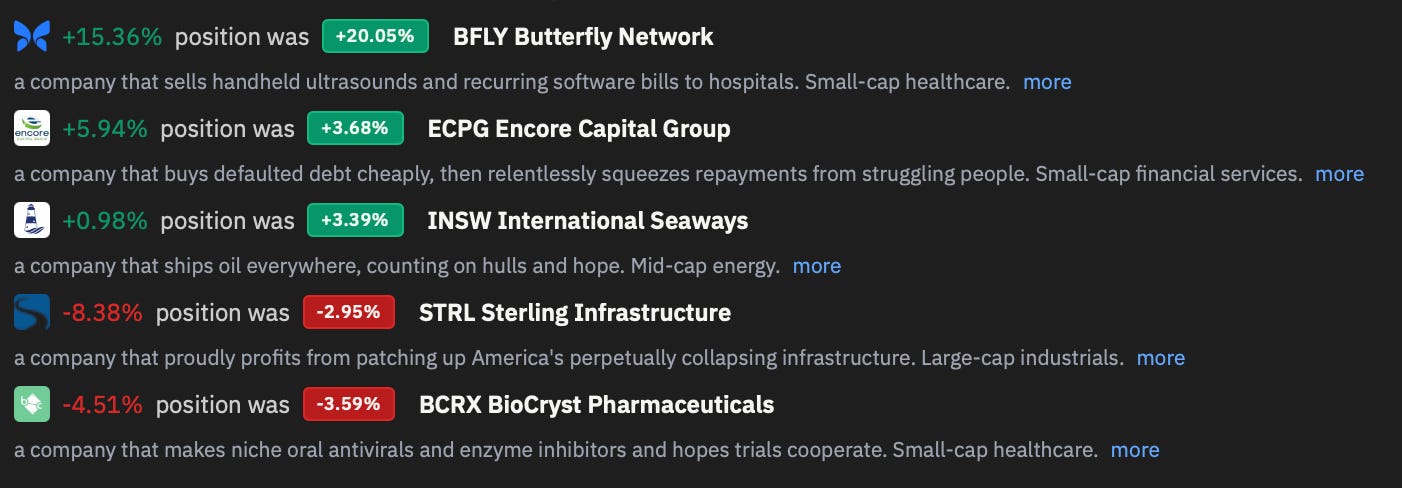
The good thing is that the sizing from last week came into effect which reduced some of the bad losses, but also limited some of the wins. Overall the fund didn’t move much until today.
I’m leaving the fund side for a moment (sizing and fund allocation) and I’m going to focus on the analysts. I’d been hoping to put out a video on how I make them, but didn’t create any new good ones and it felt a bit flat. (I am doing my best to try and make ‘man talks to screen’ interesting.)
Thankfully I’d arranged to chat that day with my friend Sam Bell who is a Machine Learning PhD and until recently an AI Research Scientist at Meta. So if he can’t help…

Sam’s idea was to focus move towards learned inference. The current approach is a rule-based system (or expert system). The decision rules are hand-crafted by the author of the prompt, which last year was me, but this year is normally Anthropic’s Opus 4.6, a frontier Claude model released earlier this month, which has certainly improved the phrasing and creativity of prompts.
But the criteria the prompts look for doesn’t change or improve unless I decide to change them. Any learning they do comes by comparing quarters within a given prompt and is ephemeral. This doesn’t really mean Money Monster is ‘learning’ over time.
The LLMs I use (normally GPT 5 series) generate a score, but they can also return features e.g. sector, # of employees, regulatory approvals, analyst reactions, the results look like this:
  “revenue_growth”: “ACCELERATING”,
  “guidance”: “NOT_GIVEN”,
  “cash_position”: “STRONG”,
These become manually tuned heuristics e.g. ‘if revenue_growth is positive , + 15 points’
The new approach is supervised machine learning. “Supervised” because I give the model labelled examples which consist of :
the features but preprocessed for comparison across all quarters
known outcome - did the stock go up or down
The decision weights are learned from data rather than specified by a human.
You can think of the scale normal programming to modern artificial intelligence as:
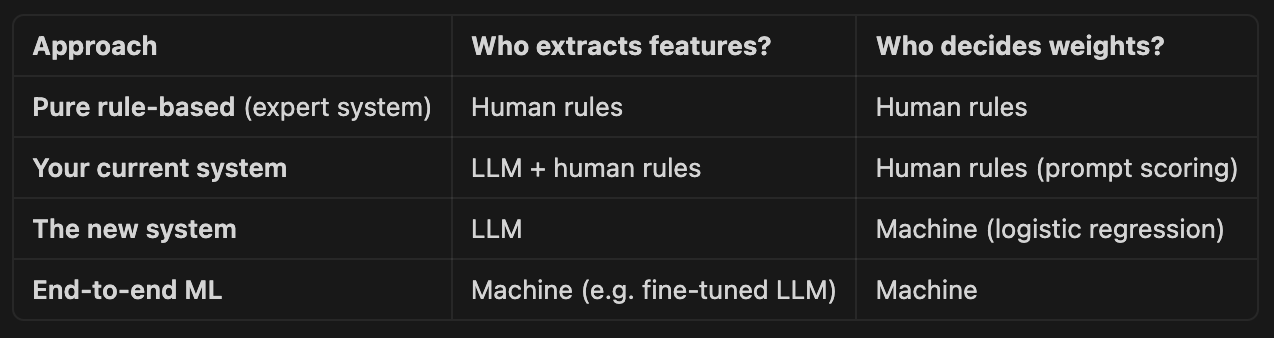
Money Monster is moving from row 2 to row 3.
Row 4 (deep learning, neural networks, real “AI”) would be fine-tuning a language model directly on transcripts to predict stock direction -- no feature extraction step at all. That’s the most powerful but needs the most data and compute. In the meantime we can :
establish a baseline to improve upon
build the infrastructure we’ll need either way e.g. features table
work out if the features have any signal at all
focus on which are the best features before expensive GPU time for fine tuning
Let’s hope Money Monster can get smarter faster.